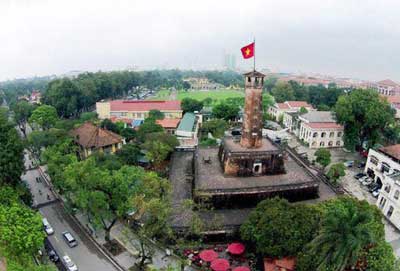
Are you exploring Hanoi’s historical landmarks? You've probably come across the image of an ancient tower with the red flag bearing a golden star waving against the blue sky – that’s the Hanoi Flag Tower. This architectural masterpiece is part of the Thang Long Imperial Citadel, a UNESCO World Heritage Site.
Despite its modest size, the tower holds over 200 years of Hanoi’s turbulent history. As one of Vietnam's iconic symbols, the Hanoi Flag Tower once played a pivotal role in military strategy.
Standing at nearly 60 meters tall (from its base to the flagpole's tip), the tower offers a perfect vantage point to oversee the entire Imperial Citadel area and beyond. Historically, it was used to monitor activity in and around the citadel, serving as both a symbol of power and an operational base to protect the Nguyen Dynasty's Thang Long Citadel.
- Address: 28A Dien Bien Phu, Dien Bien, Ba Dinh, Hanoi
- Opening Hours: 8:00 AM - 5:00 PM daily
- Entrance : Free
Conveniently located within the Thang Long Imperial Citadel, the Flag Tower is close to other notable historical sites like the One Pillar Pagoda, the Temple of Literature, and Tran Quoc Pagoda.
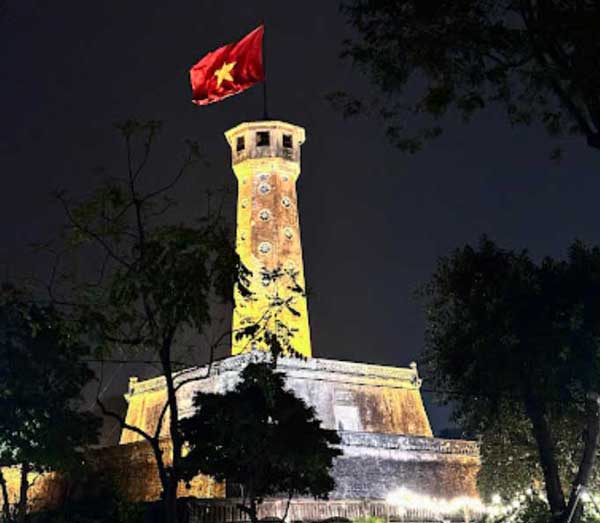
Exploring Hanoi Flag Tower
In front of the Flag Tower lies Lenin Park, while behind it is the Military History Museum. Visitors will also find a café at the base of the tower, providing a cozy spot to relax.
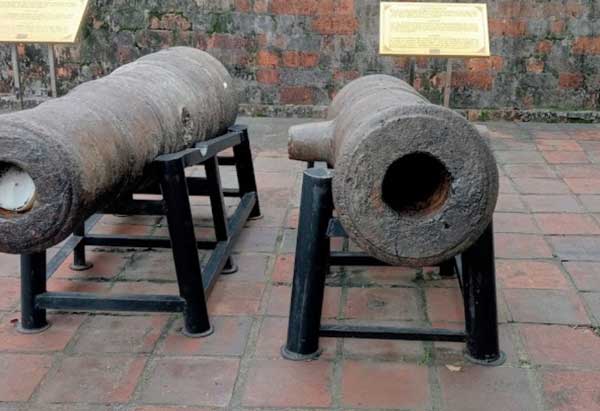
The Flag Tower consists of three accessible levels, with free entry for visitors. Combine your visit with a tour of the Imperial Citadel for a more comprehensive historical experience. At the base, you’ll find 19th-century Nguyen Dynasty cannons, discovered around the citadel area in 2003.
While the site isn’t enormous, standing at the base of the Flag Tower evokes a sense of grandeur and history.
Climbing to the top, you’ll be rewarded with panoramic views of the Thang Long Imperial Citadel and parts of Hanoi.
- North View: Landmarks like Doan Mon Gate, Princess Pavilion, and North Gate.
- East View: Hanoi Post Office and Hoan Kiem Lake.
- West View: Ba Dinh Square, the Ho Chi Minh Mausoleum, and the Ho Chi Minh Museum.
- South View: Open landscapes and modern buildings in the distance.
From this vantage point, you can appreciate the blend of Hanoi's historic and modern landscapes, with winding roads resembling delicate silk ribbons.

Visiting the Hanoi Flag Tower is not only an opportunity to admire a unique architectural structure but also a chance to delve into the nation's proud history. The Flag Tower stands as a resilient symbol and a source of pride for the Vietnamese people.
A Witness to History
Although constructed later than other Hanoi landmarks, the Flag Tower emerged during one of the city's most tumultuous historical periods.
- 1805–1812: Built during the Nguyen Dynasty, it was initially known as "Ky Dai" (Flag Pole).
- 1873 & 1882: Two battles between Nguyen troops and French forces took place here. The French later occupied the tower and used it as an observation post.
- French and American Wars: The Flag Tower served as a watchtower for monitoring Hanoi and surrounding areas.
- 1945: The Vietnamese national flag – the red flag with a golden star – was raised here for the first time after the success of the August Revolution.
- 1954: The flag was hoisted again to mark the victory of the Vietnamese resistance against French colonial rule.
- 1989: Recognized as a National Cultural and Historical Monument.
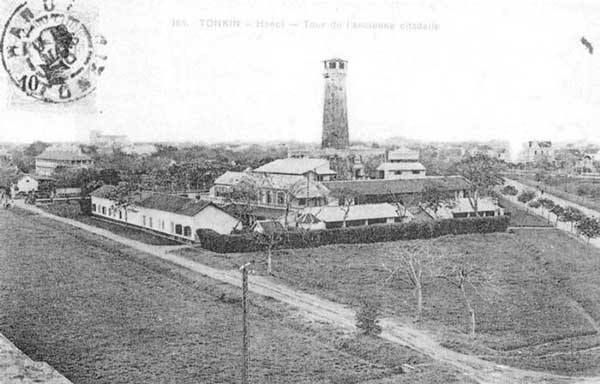
Architecture of Hanoi Flag Tower
Designed with both symbolic and military purposes in mind, the Hanoi Flag Tower was built using durable red bricks and blue stones, allowing it to withstand over two centuries of history.
Base
The tower’s base comprises three square tiers that decrease in size as they rise:
- First Tier: 42.5 x 42.5 meters, 3.1 meters high
- Second Tier: 27 x 27 meters, 3.7 meters high
- Third Tier: 12.8 x 12.8 meters, 5.1 meters high
Each tier features arched openings for ventilation and lighting. The arches are inscribed with Han characters symbolizing good fortune: "Nghenh Huc" (Welcoming Sunrise) to the east, "Huong Minh" (Facing Light) to the south, and "Quang Minh" (Radiance) to the north.
Column
The hexagonal column tapers as it rises, reaching 18.2 meters in height. The surface is adorned with floral and geometric designs for air circulation and wind resistance.
Vantage Pavilion (Summit)
Atop the column is a six-sided pavilion with windows, supporting a steel flagpole where the Vietnamese flag proudly waves.
As a strategic military structure and an enduring symbol of Vietnam’s independence and resilience, the Hanoi Flag Tower has witnessed countless historical events. Standing before it, visitors can feel the pride, hope, and determination of the Vietnamese people. It remains a symbol of Hanoi's rich history and Vietnam's unyielding spirit.

Tác giả
Temple of Literature, a proud historical architectural work of Hanoi in particular and Vietnam in general