
The Temple of Literature: 1000 Years of History
Update the Latest Information : 09/07/2026
The Temple of Literature, a historical relic in Hanoi, represents the strong emphasis on education and learning in Vietnamese culture.
Initially, it was built to honor Confucius, the founder of Confucianism, which served as the foundation of education during ancient feudal dynasties. Later, it became an exclusive learning center for the king's sons and aristocrats. Over time, the Temple of Literature evolved into Vietnam's first university, attracting talented scholars from across the country.
- Address: 58 Quoc Tu Giam, Dong Da, Hanoi
With 1,000 years of history, the Temple of Literature is undoubtedly a must-visit landmark for every traveler exploring Hanoi.
Therefore, the Temple of Literature is known as the first university of Vietnam, as well as one of the most unique architectural works and oldest historical relics in Hanoi.
The Temple of Literature is absolutely worth visiting not only for its 1,000 years of history but also for its well-preserved architecture, peaceful atmosphere, and the rare heritage of 82 Doctoral Steles recognized by UNESCO. It is one of the few places in Hanoi where visitors can truly step back in time and understand Vietnam’s deep-rooted respect for education.
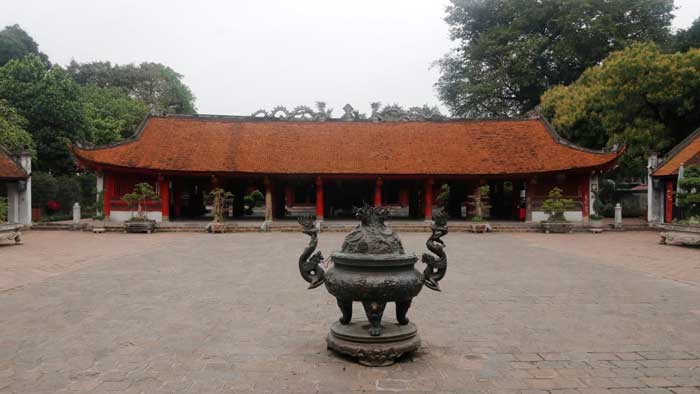
Today, the Temple of Literature retains much of its original architectural layout, with restorations made to repair damages caused by wars, closely resembling its initial design.
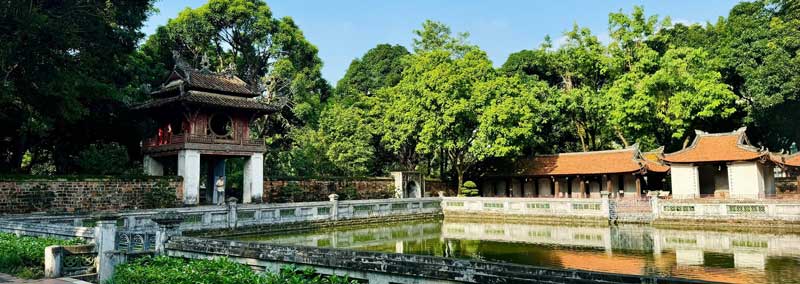
One of its most iconic structures, the Khuê Văn Các (Constellation of Literature Pavilion), has been chosen as the symbol of Hanoi. This highlights the significance and cultural importance of this historical site, not only to Hanoi but also to the Vietnamese nation as a whole.
You have two options for visiting the Temple of Literature:
- Day Tour: Offers a better view of the monuments and architecture, providing ample time to explore the details.
- Opening Hours: 7:30 AM - 6:00 PM
- Ticket Price: 30,000 VND (~$1.25 USD)
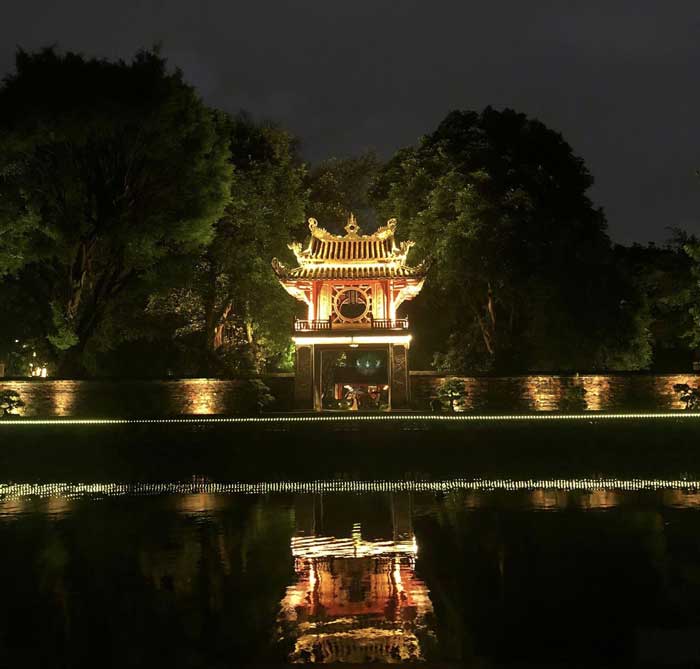
- Night Tour: Captivating and vibrant with 3D mapping art performances.
- Opening Hours: 6:30 PM - 10:30 PM
- 3D Mapping Showtimes: 7:45 PM & 8:45 PM
- Ticket Prices: Adults - 199,000 VND (~$8.25 USD), Children (1m-1.3m) - 99,000 VND (~$4.10 USD)
Ticket prices at this time may change. For the most accurate and up-to-date pricing, you should contact the management of the Văn Miếu - Quốc Tử Giám heritage site at: 024 3845 2917
Please dress appropriately and respectfully when visiting the Temple of Literature: Do not wear hats or caps, sleeveless tops, short shirts, or shorts when entering sacred areas.
The Temple of Literature is conveniently located in the city center, close to Hanoi's other famous tourist attractions.
It is just 2 kilometers from the Old Quarter and Hoan Kiem Lake. You can either walk or take a taxi or Grab ride for only 60,000 - 70,000 VND (~$2.50 - $2.90 USD) per trip.
THANG LONG – HANOI FESTIVAL 2026 : “ONE DRUM – ONE BEAT – A THOUSAND YEARS OF CULTURAL HERITAGE”
Dates: September 14–19, 2026
One drumbeat echoes through time, awakening stories of cultural heritage passed down through a thousand years.
At the rear garden of the Temple of Literature – Imperial Academy, discover the fascinating world of traditional Vietnamese drums, meet skilled artisans, experience the art of drum-making, and immerse yourself in captivating traditional drum performances.
Venue: Rear Garden, Temple of Literature – Imperial Academy Historic Site
Guide to Visiting the Temple of Literature
The Temple of Literature complex spans an impressive 54,331m², divided into five distinct sections featuring various architectural highlights. To fully explore this historic site, follow the guide below:
Discover the Architecture of the Temple of Literature
For an in-depth and detailed exploration of the Temple of Literature's structures and current condition, consider purchasing a daytime ticket.
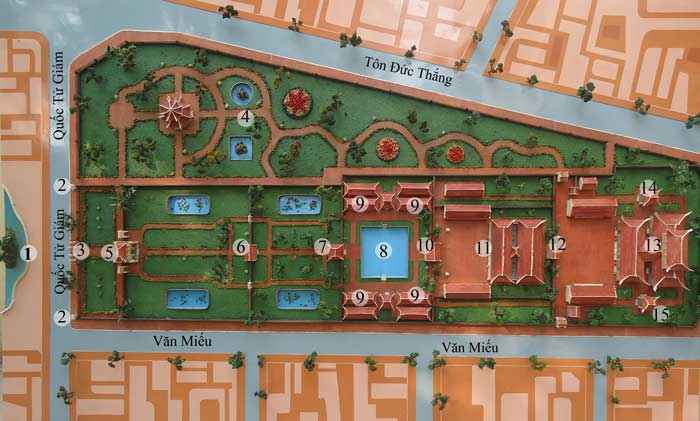
| Tourist Guide Map of the Temple of Literature - Quoc Tu Giam | |||
|---|---|---|---|
| 1 - Van Lake | 5 - Van Mieu Gate | 9 - Doctoral Steles | 13 - Thai Học Courtyard |
| 2- Ha Ma Stele | 6 - Dai Trung Gate | 10 - Dai Thanh Gate | 14 - Van Mieu Bell Tower |
| 3 - Four Pillars | 7 - Khuê Văn Pavilion | 11 - Dai Thanh Courtyard | 15 - Van Mieu Drum Tower |
| 4 - Giam Garden | 8 - Heavenly Clarity Well | 12 – Thai Học Gate | |
Before officially entering the Temple of Literature complex, you will pass by Van Lake and the Ha Ma Stele, which are considered boundary markers of the site
- Four Pillars
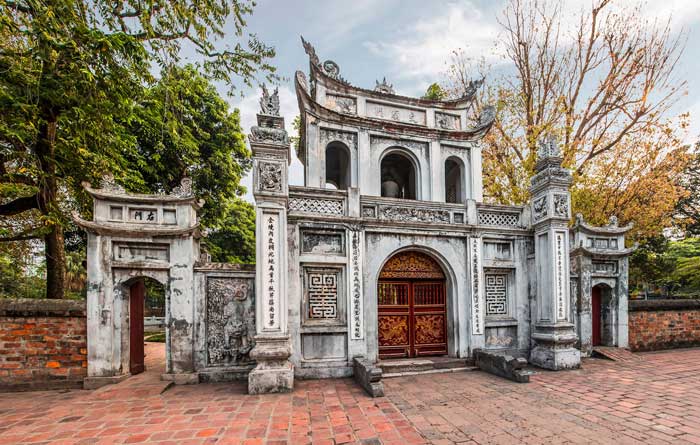
Right in front of the main gate stands the Four Pillars, four large stone columns intricately carved to symbolize the strength and resilience of Vietnam’s scholarly traditions while also reflecting the solemnity of the Temple of Literature complex.
- Temple Gate
Built in the traditional "three-gate" (tam quan) style, commonly seen in ancient Asian architecture, the central gate was reserved for royalty, while the two side gates were for officials and commoners.
- Khue Van Pavilion
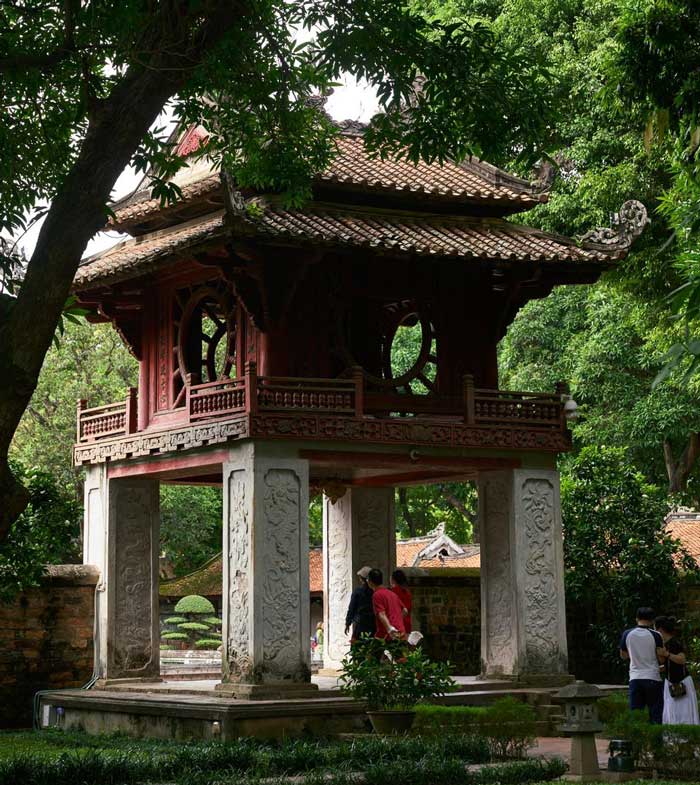
The most iconic structure within the Temple of Literature, Khue Van Pavilion was officially chosen as the symbol of Hanoi in 1997. This two-tiered structure features a solid base of four sturdy wooden pillars on the lower level, while the upper level consists of a square pavilion with four round windows representing the sky. Its red-tiled roof and intricately carved details create a refined yet elegant aesthetic. Surrounded by ancient trees and reflected in the Thiền Quang Well, the pavilion exudes poetic charm. Today, Khue Van Pavilion is a popular spot for students to visit and pray for good fortune in their exams. Symbolizing the Khue Star, a beacon of intellect and learning, the pavilion once hosted ceremonies and gatherings to honor outstanding literary works by scholars during the imperial examinations.
- Thien Quang Well
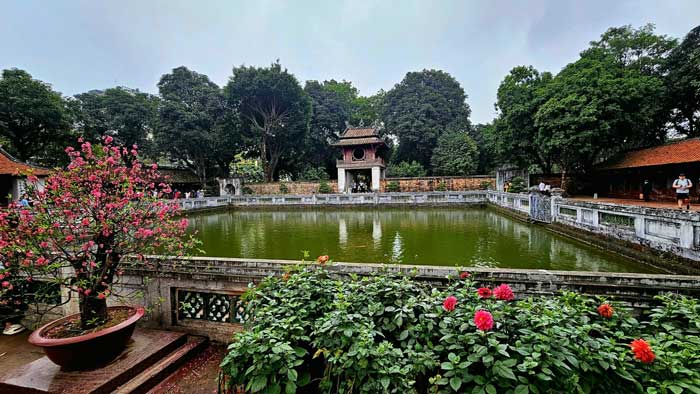
This square-shaped well, with its crystal-clear water year-round, is located next to Khue Van Pavilion. It holds symbolic significance in feng shui, representing the purity of knowledge.
- Doctoral Steles
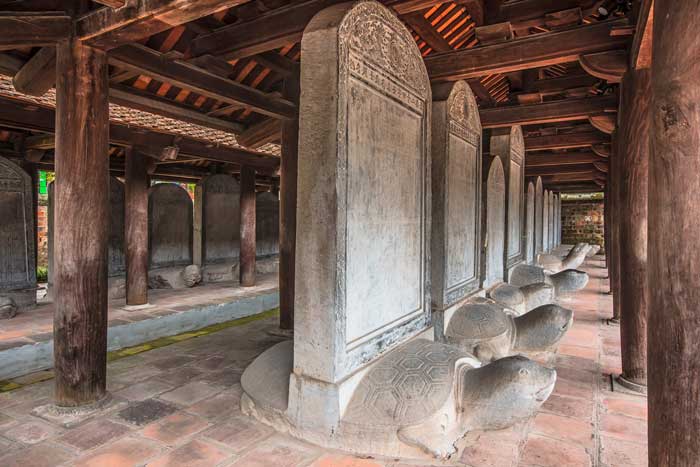
The Doctoral Steles are not only unique architectural features but also the most treasured heritage of the Temple of Literature. These steles bear the names of scholars who passed the imperial examinations over nearly 300 years. Despite historical upheavals, 82 steles remain today, each resting on a stone turtle — a symbol of longevity. The steles detail the names, hometowns, and years of achievement of the scholars. This stone stele heritage at the Temple of Literature testifies to Vietnam's tradition of valuing education and academic excellence. Among the scholars honored, many are historical figures whose stories exemplify perseverance and intellectual ambition.
- Thai Hoc Area – Vietnam’s First Educational Center
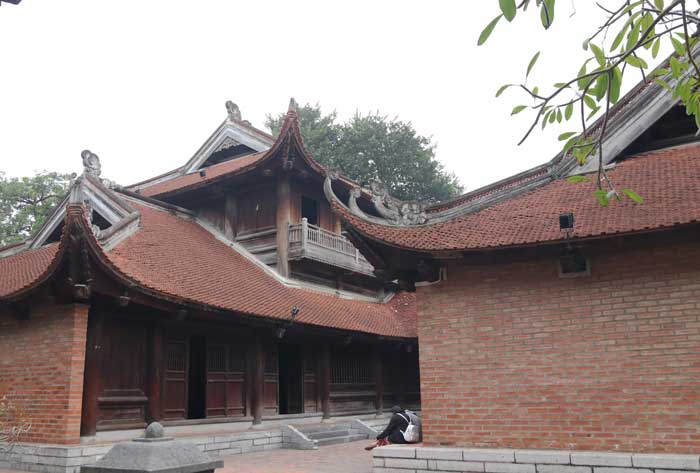
This is where Temple of Literature, Vietnam’s first national university, was located — a place that cultivated numerous talents for the nation. The Thái Học area comprises three main sections: - **Front Hall:** A venue for ceremonial activities. - **Rear Hall:** Displays educational artifacts. - **Left and Right Wings:** Spaces for students to study and rest. Visiting this area gives a glimpse into the scholarly life of ancient students and conveys the reverence for education in Vietnam’s feudal era. In addition to these key structures, you can explore every corner of the Temple of Literature complex to gain a deeper understanding of Vietnam’s cultural and educational heritage.
Enjoy the 3D mapping performance at the Temple of Literature - Quoc Tu Giam
Night tour of the Temple of Literature
Through impressive light art and sophisticated sound systems, the ancient architecture at the Temple of Literature - Quoc Tu Giam will tell stories of ancient education. Along with that, there are diverse experiences such as learning with scholars, folk games, and more.
The following map is specifically for the night tour of the Temple of Literature.
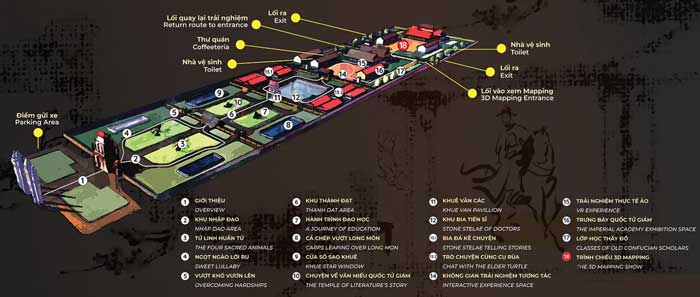
- Stone steles telling stories
The image of rows of stone steles on turtles' backs located in the Temple of Literature has become a meaningful symbol of the Vietnamese traditions of fondness for learning and honoring talented people. With the mapping projection technology, the Doctors’ steles can shake off its stone cover that has remained silent for hundreds of years, to become a very vivid storyteller about a three-century history of examinations and accomplished academics.
- Virtual Reality experience
Virtual Reality, or VR, is a system consisting of software installed in virtual reality glasses, allowing you to immerse in a new and completely virtual world, where you will almost no longer be aware of the real world around you. At the Temple of Literature Night tour, when participating in this activity you will be able to try calligraphy in virtual reality, or freely create random drawings and images against the backdrop of a starry sky. Back to list
- Classes held by old Confucian scholars
Teachers in ancient education were always respected and loved by students, the people, and society at large. The preference to respect the order of King - Master - Father was not only a cultural trait but was also an important way of life for Vietnamese people of feudal times.
At the Temple of Literature Night tour, you will not only see the image of an old Master preparing to use ink to create calligraphy works, but also be able to participate in the class yourself and feel what it’s like to become a student who studies days and nights, trying to follow his teacher's footsteps to pass the Imperial Exam.
- The 3D mapping show of “Quintessence of education”
The 3D mapping show with the theme of "Quintessence of education" will take you to typical images representing these essences and values. There are mascots such as a pair of phoenixes carrying a bundle of books and pens, a picture of the Four Sacred Animals with the Dragon, the Unicorn, the Turtle, and the Phoenix fully assembled, and the image of a carp leaping through the Dragon Gate, symbolizing Confucian students diligently studying with the hope that one day the carp will turn into a dragon, and their names will be carved on the Doctors’ steles. You can also admire the glorious beauty of the Khue star, the constellation of knowledge that always brings the light of wisdom to all living beings, guiding every Confucian student on the path of learning. Besides, one of the most vivid proofs of the convergence of educational quintessence is the Doctors’ steles. The creation of these stone steles involved not only the craftsmanship of the engravers, but also the convergence of all the quintessence of all things in heaven and on earth, all together bestowing on the academics their highest honor.
Video 3D mapping : Temple of literature
In addition, there are over 10 interesting and meaningful experiences about the education of the Vietnamese people, both past and present. Come to the night tour of the Temple of Literature to explore all these exciting programs!.
Hotels
History of the Temple of Literature
The Temple of Literature, Vietnam's first university, operated for nearly 1,000 years and remains one of Hanoi's most significant historical landmarks. Despite changes across dynasties, the Temple of Literature - Quoc Tu Giam has always been highly valued and developed.
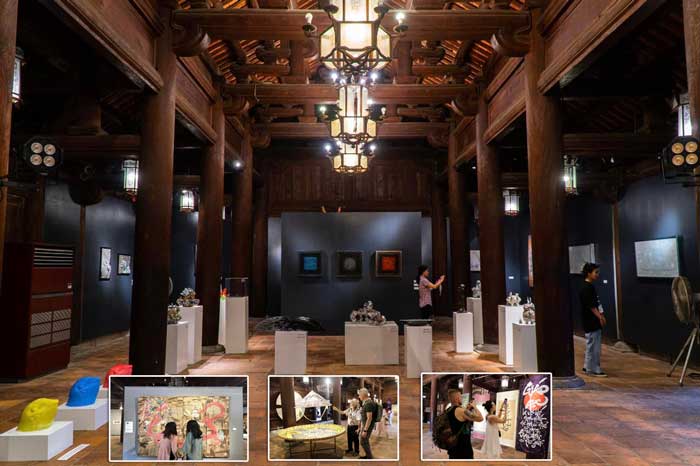
This site has undergone key milestones throughout history:
- 1070: Emperor Ly Thanh Tong built the Temple of Literature, erected statues of Confucius, Zhou Gong, and the Four Sages, and initiated ceremonial worship while allowing the Crown Prince to study here.
- 1076: The royal court established Quoc Tu Giam, the first higher education institution for royalty and the elite.
- 1253: During the Tran dynasty, Quoc Tu Giam was renamed Quoc Tu Vien.
- 1483: Under the Le dynasty, Quoc Tu Vien was renamed Thai Hoc Duong.
- **Nguyen dynasty**: The Temple of Literature - Quoc Tu Giam became Hanoi Temple of Literature and continued its role in religion, education, and worship.
- 1999 - 2000: The Thai Hoc area was restored by the state to preserve and promote the value of this historical site.
- 03/2010 : 82 Doctoral Steles from the Le and Mac dynasties at the Temple of Literature - Quốc Tử Giám were recognized by UNESCO as a World Documentary Heritage in the Asia-Pacific region.
- 07/27, 2011 : the 82 Doctoral Steles were further recognized as a World Documentary Heritage on a global scale
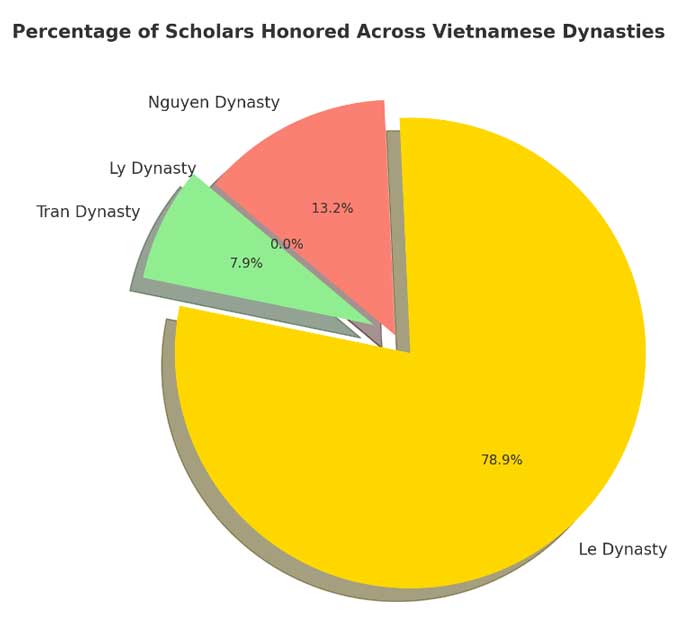
The chart represents the percentage of scholars honored across different dynasties in Vietnam
Historical sites near the Temple of Literature
Hanoi today is vibrant and modern, yet it still preserves many historical sites dating back thousands of years. Besides the Temple of Literature, you can further explore Hanoi's rich history and culture through the following architectural landmarks:
- Hanoi Flag Tower:
Built in 1805 and completed seven years later, it served as an observation tower. Standing 33 meters tall, this tower is considered one of the symbols of Hanoi.
- Address: 28A Dien Bien Phu Street, Dien Bien, Ba Dinh, Hanoi
From the Temple of Literature, it’s just over 1 km to reach the Hanoi Flag Tower.
- One Pillar Pagoda:
Constructed in 1049, earlier than the Temple of Literature, this pagoda has a unique architectural design resembling a lotus flower. The current One Pillar Pagoda was rebuilt in 1955 following the Nguyen dynasty's original design.
- Address: One Pillar Pagoda Street, Ba Dinh District, Hanoi
You can walk from the Temple of Literature to the One Pillar Pagoda, covering a distance of approximately 1.2 km.
- Hoan Kiem Lake:
This area is home to many ancient architectural landmarks of old Hanoi, with Turtle Tower being the most iconic, located in the center of the lake.
- Address: Trang Thi Street, Hoan Kiem District, Hanoi
It’s a bit over 2 km from the Temple of Literature to Turtle Tower and other historic structures around Hoan Kiem Lake.
- Thang Long Imperial Citadel:
This vast complex of historical relics, over 1,000 years old, holds traces of history spanning 13 centuries. The Thang Long Imperial Citadel was recognized as a UNESCO World Heritage Site in 2010.
- Address: 19C Hoang Dieu Street, Dien Bien, Ba Dinh, Hanoi
Located just 1.2 km from the Temple of Literature, it’s convenient to walk there.
Are you ready for your visit to the Temple of Literature and a historical tour of Hanoi?